Showing posts with label Random. Show all posts

Monday, July 23, 2012

The most "awesome" blog post ever

I realized it this morning when I called the pharmacy to ask for a prescription refill. The person on the phone told me my medicine would be ready after 11, and I responded, “That’s awesome. Thanks!”

Then I hung up the phone and thought, “Wait – that was good service, which is nice and all – but it probably wasn’t really ‘awesome.’”

And then I thought some more, and it hit me that I’ve gotten into the habit of over-emoting in response to mundane things. “Amazing” and “awesome” are two of the adjectives that immediately come to mind.

And I’m not the only one who’s fallen prey to this tendency: A friend visited Chicago this past weekend and posted on Facebook that his trip was “awesome.” (Was it really? Or was it just relaxing and fun?) And as I was exiting the elevator, a man told a woman on my floor to have an “amazing” week. (How about just an uneventful, productive one?)

I decided to do a little research on how the over-emoting tendency happened to evolve. Here’s what I found out: not much. Linguists don’t seem to have much to say on this topic. But some trace using the word “awesome” to describe things that are not to – I kid you not – Spicoli.

Who was Spicoli, those of you not as ancient as I am may ask? Jeff Spicoli was a surfer-dude character portrayed by Sean Penn in the 1982 movie “Fast Times at Ridgemont High.” Spicoli was perpetually stoned and, in one key scene, had a pizza delivered to his high-school classroom. Spicoli was, many would say, awesome.

But I digress.

Here are some things that are truly awesome, or awe-inspiring: the Grant Canyon. Niagara Falls. Stonehenge. The birth of a child. Surviving a plane crash. The word “benign” on a pathology report.

Here are some things that are not awesome: a new package of post-it notes. A good haircut. A trip to the Amana Colonies (unless you, or someone you know, gives birth there). A piece of gum, even if it’s really flavorful. A refill of my thyroid medication.

As a younger person who wanted very badly to be taken seriously in my professional life, I was very careful about my word choices. Now, as an old, lazy person who’s confident in her ability to make a living with the use of words, I’ve ironically become careless in the way I use them personally.

When I really think about it, what gets me is that using words like “awesome” and “amazing” makes me feel silly and sort of disappointed with myself for being unable to come up with anything better.

And others apparently are disappointed with me as well, even people I don’t know: I just read that an English poet has launched a campaign to stem the overuse of “awesome” … which is great, but ironic in that the English are just as guilty as overusing the word “brilliant.” (This I know first-hand, as I just returned from an awesome, brilliant trip there.)

In an effort to remove the words “awesome” and “amazing” from my vocabulary, I’m going to make an effort to match my adjectives the emotions that the particular actions generate in me. To the pharmacist: “That’s really helpful; thanks.” To the car dealer who comes down $1,000: “That’s a relief; I think I can work with that price.” To a friend who’s hired for a new position, perhaps a simple “Congratulations; that’s great news.”

But as I mentioned, I’m lazy. And I know myself; my best-laid plans often don’t make it out of the starting gate. But if I can at least be aware enough to improve my vocabulary, maybe people will be better able to focus on what I’m saying rather than how I’m saying it.

And that, in a word, would be … satisfying.

Certainly not awesome.

Sunday, July 15, 2012

Wallowing in nostalgia can make you happier? See, I told you so.

As my dad grew older, one thing we noticed was that even though he often could not remember what he'd eaten for breakfast that morning or the dog's name, he could recall, with startling clarity, things that had happened during his childhood. In fact, as he lay in a hospice facility getting ready to leave us all, he frequently conversed -- and often laughed -- with his mother, who died in 1936.

I thought about that this morning as I perused the posts on Lost Des Moines (LDM), a Facebook group page that's one of my favorite haunts. (And before I go further, let me address this: Yes, I'm online a lot. But I justify this, when people ask how I find the time, by telling them quite truthfully that with the exception of the news and a few weird cable things, I don't watch much TV. So while my husband is indulging in seven straight episodes of "The Walking Dead," you can find me at the computer. That's not a value judgment; it's just the way we are.)

Anyway ...

My time on LDM has reinforced the fact that people -- myself included -- are comforted by nostalgia. That's not news, but the revelation for me, I guess, was that you don't have to be 850 years old to want to turn back the clock and spend some time in the Land of Long Ago.

It also struck me, as I became familiar with some of the LDM regulars, that they aren't housebound and bored; with very few exceptions, the folks who spend the greatest amount of time on LDM are busy people with full lives.

So I decided to do a little research on why we enjoy talking about department stores that are long-gone, how we felt about our kindergarten teacher or whether the ice-cream man came down our street. According to BBC News' Stephen Robb, it's pretty simple: We like to talk about the past because it makes us feel good.

In a report for the BBC in 2010, Robb cites a study from the University of Southampton that found remembering past times "improves mood, increases self-esteem, strengthens social bonds and imbues life with meaning."

"Most of our days are often filled with with routine activities that aren't particularly significant: shopping for groceries, commuting to work and so forth," the article also quotes psychologist Clay Routledge of North Dakota State University as saying.

"Nostalgia is a way for us to tap into the past experiences that we have that are quite meaningful -- to remind us that our lives are worthwhile, that we are people of value, that we have good relationships, that we are happy and that life has some sense of purpose or meaning."

The article also quotes experts as cautioning people against wallowing constantly in nostalgia. For most of the people I know, though, it's not that way; LDM is more of a nightcap, a place to spend 10 minutes talking about making out at Lost Planet or waiting in the parking lot for Valley West Mall to open on its very first day.

It's also, I think, a way for us to be reassured that we simply belong. My husband and I grew up in different states, so we have no shared frame of reference; it makes him feel comforted, then, to talk with folks back home about their common experiences, just as it makes me happy to talk with others who remember when Valley High School sat on a dirt road and 50th street in West Des Moines was "out in the country."

I do enjoy wallowing in nostalgia, I guess, from time to time. But I'm also very much present in the here-and-now, so I think there's probably a healthy balance there.

Now, if you'll excuse me, a conversation is starting on LDM about Heaven to Seven, an Urbandale store where I was fitted each year for my grade-school uniforms. If that rivets you as much as it does me, take a few minutes and stop on by.

Wednesday, June 20, 2012

Cutting the Apron Strings: How's That Supposed to Work, Again?


When I'm willing to be truthful with myself, I have to admit that parenting older children is all about the relevance. My own relevance, that is.

It’s a sad fact of our existence (cue the Lion King “Circle of Life” music) that that as our children age, we become less relevant to them. When they’re little, their entire lives revolve around us, and ours around them as well; in the most real sense, after all, we’re trusted with keeping them alive.

But then something really underhanded transpires: Their grasp on us loosens and they begin inching away, and before long, they’re gone altogether. And we’re left wondering what in the world just happened.

My kids are -- could it be? -- almost 24 and almost 21 now. It’s safe to say that because they’ve constituted the area of my life into which I’ve most totally immersed myself, I’m a little unmoored these days. I’ve really, really enjoyed being their mother, and with a couple of notable hiccups, I think I’ve been pretty good at it. And I know that while my job will never been finished in a figurative sense, I also need to face the fact that each of them could get along just fine without me.

So, you see, as an intellectual individual, I understand how it works. So why is it that I keep grasping?

Let me say this right off the bat: I’m a busy person. I work full-time, and I also maintain what constitutes a full-time freelance-writing business on the side. Most nights, I’m covering events or writing stories. I have a husband whom I love and enjoy spending time with, and we have a high-maintenance dog. So it’s not as though I don’t have a life.

It’s just that the life I have is so different from the one I lived for so long. And I’m not sure what to do with myself if -- emotionally, anyway -- no one needs me anymore.

Here’s what Caroline would say right now: “Mom, stop being dramatic and feeling sorry for yourself.” Well, Caroline, I’m Italian and I’m right-brained, so to some degree, I’m guilty as charged. But I’m truly not trying to immerse myself in pity; I'm trying to determine how all this supposed to work. And I also wonder sometimes if I’m the only person who feels this way.

Some of my friends love having an empty nest. They’re living like college kids, albeit ones with more money. I’m sort of jealous, as I just can’t get into that groove.

The reasons might be as simple as accepting my heritage. It’s stereotypical and demeaning to assume that all Italian mothers emotionally smother their kids … right? If not, I’ll just go with that. (Visit YouTube and watch a few scenes from the movie Moonstruck. That’s my family.) In all seriousness, though, I come from a long line of matriarchal women who like to make sure everyone is well-fed and happy. I’m not much of a cook, but I have the nurturing thing down pat.

I realize that sometime soon, I’ll need to begin making changes. I anticipate both my kids will marry eventually, and I don’t want to scare their spouses; I also don’t want to be an overbearing grandmother who insists on offering unwanted advice. I want to remain close to my kids, but I want them to be able to count on my knowing my boundaries.

I also want to continue to be relevant to them, though. I don’t want to be the old lady who doesn’t matter. I want -- as we all desire in the important areas of our lives, I think - to continue to add value.

In all other areas of life, Mother Nature seems to have it right. As we age, hormones change and help us shift our focus from making babies to raising them; we focus less on the laws of attraction and more on creating stable, sturdy, reliable environments for our kids. That’s not to say that we stop being individuals, but we stop being entirely self-focused and self-centered ones. Why, then, can’t the same fluctuations allow us to love our children not quite so fiercely?

I suppose, to some degree, this will all take care of itself, and it might all be OK; after all, I’m trying to keep a respectful distance from Scott’s decisions about where his life will take him next, and, on an albeit smaller scale,I wasn’t even taken aback when Caroline said she didn’t a ride to the airport because her boyfriend was taking her.

I'm trying to do better. But I'll also promise you this: Wherever my kids go next, and no matter how respectful a distance I’m able to keep, it won’t stop me from fretting over whether they make sure to eat a good meal before they get started.

Hey -- it's all about the baby steps.

Wednesday, June 13, 2012

Magic in their hands, food in my yard


Food is growing out of my yard. That that can happen has never ceased to amaze me.

For Mother's Day this year, Kevin bought me dirt. And dirt, luckily for him, was just what I wanted. He had tilled part of our yard last summer with the hope of putting a garden in, but ended up getting busy with a few dozen other things. And with my knee pain an 11 on a scale of 1 to 10 prior to my surgery, I didn't push it.

But this spring, after healing from this year's health woes and starting to feel pretty darned good, I was ready. So I may have whined just a little, and he surprised me with some beautiful black soil.

And into it, we burrowed some tiny seeds, as well as some starter plants made available to us by a generous neighbor. Growing from seed is really my preference; you have to wait longer, but what a sense of accomplishment.

Kevin texted me at work the other day. "Carrots!" the text said. And today, it was "Peas!" And sure enough, when I got home, I saw what you see in the photo above.

We're growing food. And that thrills me.

Kevin and I both have good jobs. We've never gone hungry. But there's something about knowing you're helping to provide for your family through your two hands and Mother Nature -- something much more satisfying than wheeling a cart around the grocery store.

When my kids were little, I gardened, and they helped me. We harvested potatoes, carrots, pumpkins, enough peas for one dinner (and I burned them!), and enough raspberries to feed the neighborhood. I still remember how thrilled the kids were to stuff the berries into their chubby little faces as we waited on the front porch for the kindergarten bus.

Their chubby little faces -- not so chubby now -- are in their own apartments now. But I know they share the memories.

Gardening also ties me to the more distant past. In the 19-teens, my grandparents -- both sets -- came to this country, like so many, in search of a better opportunity. They brought little but some clothing and meager belongings, yet they had magic in their hands. One of my grandparents died before I was born, and two more passed away the year I turned four. Yet I've seen the pictures and heard the stories, and I'm pretty sure I have a few snapshots in my own head.

My Grandpa Joe's meticulous gardens on Sixth and Jefferson with their straight, straight rows and splashes of color. My Nana's vegetable garden in her back yard that looked out on St. Anthony's school; I remember her hunched over, pulling peppers, in her black house dress and white apron. To me, her house forever held the smell of vine-ripened tomatoes, big as cantaloupes, stewing in olive oil.

Their wealth was in the food that grew from the ground they cultivated. I wish I remembered more about them, but I like to think that as they passed from this world to the next, they whispered something in my ear and slipped a little magic into my hands.

I can't sing, I can't play an instrument, and I can't throw a football. But I can make food grow from my yard. Each time it happens, it amazes me. And this year, I'll try hard not to burn the peas.

Tuesday, May 8, 2012

You're a freelance writer? Maybe not.


When someone asked the other day about my occupation, I told her I have two: I work during business hours as a professional communicator for a financial-services provider, and at night and on weekends -- and occasionally at lunchtime -- I'm a freelance writer.

Her response? "Oh, I'm a freelancer, too!" I asked her what publications she writes for, and she said, "Lots of them! I write stories and send them to websites and magazines." After a little more conversation, it became clear that the woman is indeed a writer, but she's not a freelance writer.

I'm splitting hairs now, I know. But the conversation irritated me.

It didn't irritate me because I corner the market on freelance writing, by any means, or that I'm a better writer than this woman or anyone else. It bothered me because I believe in this distinction: If you're not getting published, let alone paid for it, you're not a freelance anything. Not yet, anyway.

And here's an illustration to show you why that is. I'm fairly good at baking; I love to create cakes and brownies and pies and all sorts of options to satisfy the sweet teeth of the people I care about. But when someone asks me what I do, I sure don't reply, "I'm a baker." Why? Because I'm not. It's a hobby and a pastime, but no one pays me to do it, and I'm not trying to build a business from it.

I'm also not a professional blogger. Blogging is not freelance writing; it's writing, no doubt, and it's a passion and an avocation and something I engage in to express myself. But no one is advertising on my site, and I obviously don't earn a penny for it.

I do earn some pennies freelancing, though, in large part because I've worked really hard and earned the trust of some good people. My editors know these things about me: I'm accurate, I'm thorough, and I meet my deadlines. There are a ton of good reporters and writers in this market, but because I've been around for quite a while and have rarely screwed up -- we won't mention the mayor whose name I misspelled back in the day -- my editors know they can count on receiving a usable story from me without investing a whole lot of time and energy.

Also, freelancing isn't easy. Try covering a meeting at which you don't know any of the players and aren't familiar with any of the issues and finding a way to get a story out of the whole thing anyway. Freelancers -- many more than just myself, obviously -- do that daily, and often after working a full day somewhere else.

And in this age of "anyone can be a writer" social media, I take pride in the fact that I was taught well, and that I know the mechanics necessary for a person to make herself readable. Don't get me wrong -- I love that social media has brought out the writer in so many of us, and I freely encourage everyone I know to jump on board. But if you're not on deadline, you don't do what I do. That doesn't make your writing any less valid; it just makes it a different type of writing.

Writing is one of those things in which we all participate, like eating and walking and bathing, so it's probably a little harder to determine a degree of professionalism than it would be for, say, a sword-swallower or a rock climber. (If I were to say, "I climb mountains" -- and that were true -- you'd be less likely to say, "Oh, so do I.")

But if I were to be totally honest, maybe there's more to this: Maybe I'm protective of my writing because it's the one thing that's always defined me. As a little girl, maybe I didn't have a mom and maybe I was too tall and maybe I was awkward and nervous and had bad hair. But with a pen or a typewriter, I wasn't "less than." I had all the confidence I needed.

So I guess it comes down to this: I am not the only game in town by any means, and I'd lend my full support to anyone who wants to be a freelance writer. If you want to be one, don't stop trying; chances are your hard work eventually will pay off.

But until that day, respect the fact that for quite a few of us, writing is not a choice; it's not a hobby. It's a way to pay the bills and, if we're lucky, create something that might make a difference to someone.

Don't call yourself a freelancer, and I won't call myself a mountain climber ... that is, unless I become one. Anything can happen.

Friday, March 9, 2012

Why others' opinions of us sometimes should count more than our own


My very (non)-favorite (non)-singer, Rihanna, has a song out now that’s one of the most irritating I’ve ever heard; something about “I found love in a hopeless place.” Well, last night, Here’s what I found:

Grace. In a place not at all hopeless, but altogether unexpected.

(This post has nothing to do with Rihanna -- thankfully, as I cannot stand her -- but sometimes a writer can’t figure out just how the heck to lead into something. That didn’t quite work. But here we go.)

I currently serve as the chair of a nonprofit group that helps support the fine arts at Drake University, my alma mater and the university my daughter attends. (Keep reading. This isn’t a pitch, I promise.) I love Drake, and I believe wholeheartedly in this group and everything it stands for and accomplishes. We meet once a month, and between meetings, I typically work a few hours a week on issues relating to our efforts. I have a binder and notebooks and a system that works for me.

Only it doesn’t always work, though, as I realized this week that I had dropped the ball on something pretty big. A reminder about a deadline had come to me while I was having one of the surgeries I’ve seemed to enjoy so much lately, and although I had made a mental note to take care of this issue, I hadn’t addressed it. At all.

So the result was this: One of our tried-and-true, high-profile fundraisers – one that helps raise money and awareness for the programs we help to support – isn’t going to happen this year. Period. No adjustments can be made; I missed the deadline. End of story.

To say I was absolutely sick when I realized my oversight doesn’t do justice to my feelings of panic and dread; I emailed a couple of officers in the group right away, but knew I’d have to face the entire committee yesterday to issue a mea culpa. As the agenda items ticked off, I broke into a cold sweat. Then it was time to tell the group what I had done.

I was honest, taking full responsibility for the mistake. As I yammered on about the details, I almost started crying. Thankfully, that didn’t happen. I finished, and there were a few seconds of silence. And then the most amazing thing happened.

This group of about a dozen people immediately set about making me feel better. My predecessor, who now serves as vice-chair – an amazingly busy but always-together person – was the first to say, “We’ve been wanting to ‘go rogue’ on this for a while now. This might just be a great opportunity to see if we can do that.”

At the end of the meeting, we had a plan: One of the committee members is going to determine if we can host our own similar event outside the auspices of the umbrella group with which we had been working. The group was energized and excited, and I was surprised and humbled.

Like many busy people who wear a lot of hats, I tend to be hard on myself when things don’t work correctly; in this instance, a few things could have transpired differently to ensure that the deadline was met, and not all of those were on my plate.

But still, the buck stops with me. And because I tend to take on too much and end up beating myself up, I had spent 24 hours feeling pretty darned worthless and low.

I wondered, though, why I had underestimated these people. They’re all high-achieving, busy, and passionate about the causes they believe in, and chances are each one of them, at one point or another, has mucked up something important. Why had I anticipated their wrath rather than the kind, affirming responses I received, most along the lines of “You do a great job – stop being so hard on yourself”?

Because of the way the world is, I think – because of the way we’re always moving too fast and sleeping too little. Because our emotions are fraught and we’re pulled in too many different directions. And maybe because some people – ones with whom we come into contact all too often – are quick to lash out when things don’t go their way.

Everyone who makes a mistake should have the privilege of coming into contact with – and being embraced by – the good people who had my back last night. After all, reactions such as theirs are extra motivation not to screw up next time.

Wednesday, March 7, 2012

Stop smelling like smoke.


My husband is a smoker, and I love my husband. He has tried to quit umpteen thousand times in just the few years that we've been married, and I've seen him really, truly struggle. And, full disclosure: In my younger days, I was a social-smoking kind of girl.

So to a degree, I understand -- or used to understand -- the allure of a freshly lit cigarette; it was something to focus on, to hide behind. I was never addicted, but that doesn't mean I'm somehow better than people who are.

Which brings me to my rant. If I smelled like cow poop or nail-polish remover or ether -- not just smelled like it slightly, but smelled as though I'd been rolling in it, rubbing it into my scalp and massaging it under my cuticles -- I would expect someone to bring it to my attention and perhaps ask me to improve my personal hygiene. So why is smelling of smoke -- no, reeking of it -- absolutely OK?

I love to ride the bus to and from work. I can't do it every day because sometimes I have to go straight from the office to after-work commitments, but on days I'm able to ride, it gives my day an extra lift. Cheesy as it sounds, there's something about knowing I'm saving money and doing the right thing for the environment that puts a little spring in my step. I climb on and relax for half an hour, often reading or playing Words with Friends as I travel from park-and-ride to office and back again.

I'd been riding a certain route for several months when it occurred to me that another park-and-ride was closer to my house; in addition, it allowed me to travel east -- the direction of my office -- instead of west, which takes me out of my way. So, armed with a route map and a smile, I drove to the new park-and-ride a week or so ago, climbed aboard the waiting vehicle and settled in for a relaxing trip to work.

But it wasn't relaxing; unbeknownst to me, I had chosen what appeared to be a smokers' bus. Passengers weren't smoking, obviously, but they smelled as if they had been enjoying an unfiltered Camel in a very small, closed bathroom, then stubbing it out just as they hit the bus steps.

The riders were perfectly nice. They smiled. They chatted amiably. But the staleness made my stomach turn, and I actually smelled of smoke myself, as a co-worker told me, when I arrived at my office. Because of the aroma issue, I've had to make the decision to return to the less convenient route. And that irritates me.

This isn't just a bus issue by any means; one of the guys at my bank reeks of smoke, as do a couple of servers at the restaurant Kevin and I like to frequent. A hairdresser who was a heavy smoker used to cut my hair years ago. I've smelled smoke on physicians and nurses and ultrasound technicians and cable-TV repair folks, and the few times we've been to a casino, I've headed straight to the shower as soon as I've gotten home.

So I don't really enjoy smelling smoke in any venue, but there's something about the odor when I'm moving that turns me more than a little bit green. Yes, it's absolutely a person's right to smoke. But isn't it my right not to have to smell it?

Kevin is a considerate smoker. He smokes outside and does a good job of airing out before he comes back in. Do I smell smoke on his clothes and in his hair? Occasionally, and I'll often say "You reek" or something similarly adorable to drive him to the Febreze. I'm not about to tell total strangers they reek, so what's the answer?

There isn't one. This morning, the bus driver commiserated with me; he doesn't like the smell, either, but it's not as though he can ask his riders to change clothes before they hit the steps. Thankfully, there are other buses to ride; I also can choose to change bank branches or not sit in the sections of waiters who historically have smelled like tobacco.

I guess I just want people to know this: If you smoke, you smell. You may not think you do, but you do. So if you're going to be around other people in an enclosed space, please consider not lighting up until you're done being around them. If you agree to that, I promise I won't roll around in garlic or mothballs or paint thinner until we've parted ways.


(Disclaimer: If you're thinking of riding the bus, don't let this post dissuade you. I'm talking ONE bus in a fleet of hundreds. Statistically, chances are that if you rely on DART to get you where you want to go, you'll arrive at your destination smelling like a daisy.)

Sunday, February 26, 2012

Let's hear it for the boys


A few days ago, my friend Jeff posted a photo in which he and another of my almost-lifelong friends, Bill, are standing in front of an ice-cream shop. It's a typical photo, albeit a bit whimsical; we're all in our late 40s now, and going to the ice-cream store probably constitutes a little more fun than we have in our everyday lives.

The photo made me smile for any number of reasons; the years have treated both men well, and the faces that smiled back at me were the ones I remembered from our high-school days. But the way I felt was derived from more than that; these guys, and a few others, were a huge part of my history. And my friendships with them were considered a bit odd in an age where, as my dad often told me, "Nice girls don't call boys."

I don't think I'm the only woman who has ever been more comfortable having friendships with guys than with girls. During my formative years, from junior high through college, although I had female friends, my maximum comfort level was achieved when I hung out with boys. (And let's cut to the chase here -- I'm talking about platonic friendships. The guys who were my friends were not the ones I dated.)

Friendships didn't work out with all guys, mind you; I gravitated toward the ones who had more to them than met the eye. They weren't necessarily the jocks or the student-council representatives; they were nice guys who liked to write or read or listen to music or talk for hours. It was easy to open up to them about other, less worthy boys, or about school anxieties or family issues.

And the crux of it was just that: They listened, and they didn't seem to judge. We attended a Catholic school, and through eighth grade, we were grouped with the same 40 kids, give or take, year after year. We all knew each other, and we all had formed opinions, right or wrong, about our classmates.

In some ways, I was a square peg in a round hole. My hair wouldn't part in the middle and "feather back," and I read the dictionary for fun. I was also the only person in my class who didn't have a mom. Maybe some of my perceptions about others' opinions of me weren't correct, but at that point in my life, I didn't feel I fit in.

And my guy friends didn't care. They seemed to value the fact that I was smart and a good listener, and that I wasn't too shy to ask the kinds of questions that would lead them to talk about things they had wanted to talk about, but didn't know how. They didn't care that I had glasses and looked nothing like Marcia Brady, or that I was way too tall, having hit my full adult height of 5'4" when I was all of 11.

And there was more: If one of them liked a girl and was reluctant to let her know, I was the go-between, the eighth-grade romance broker. And I was also there to sympathize with them if that first crush just didn't work out.

High school and college were much the same, but on a different scale because I had boyfriends to factor into the equation. Everyone caught up to me in height and I lost the glasses; I was suddenly dateable, but that didn't put an end to my relationships with my guy friends. I still laugh at a yearbook inscription from the guy who was my boyfriend for two years in high school: "You spend more time with Marty and Steve than you do with me, and that's kind of weird. But I guess it's OK."

In retrospect, the fact that my guy friends valued me for the person I was had a great deal of bearing on the fact that I reached adulthood with my self-esteem intact. A boyfriend may have turned out to be not so great, but Bill or Jeff or Chris or Steve or Marty or Tom was there to remind me that my self-worth should be derived from so much more than the opinion of a boy who had dumped me because he fancied someone blonder or skinnier.

Don't get me wrong; I had some tried-and-true girlfriends during those years, too. Tricia and Susan and Francie and some others helped me understand that not everyone was a "Mean Girl," and my friendships with them, all of which still endure to some degree, led me to reach out to some of the women who are my best friends today.

Male/female friendships are more difficult in the adult world; I still have them, but they're different, as no one wants to be perceived as a boundary-crosser. I'm really happy, though, to see that each of my kids has close platonic friends of the opposite gender, and that my husband counts at least one woman among his closest allies at work.

As I look at the picture of Jeff and Bill and see photos of some of my other pals and their wives and families on Facebook, I wonder if those guys have any idea just how much they meant to a girl who was trying to find her way in the world. I doubt they realize that just by being themselves, they helped me let down my guard, let people in and begin to reach out.

My ability to be a good person in adulthood -- or to try to, anyway -- was shaped, at least in some degree, by their tutelage. And all these years later, as I smile at those still-young faces in the photo, it's high time to say "thanks."

Wednesday, February 22, 2012

Willie Nelson, Claymation pigs, and ... why can't I stop crying?


Ever since I can remember, I’ve worn my emotions on my sleeve – ad nauseam, in fact. When I was 9, I hung a sign around my neck before a family gathering that read, “I’m irritated and I don’t feel like talking.”

But this is ridiculous.

I’m chalking up to hormones the fact that I cry at the drop of a pin. I cry so much that it can be highly embarrassing and probably makes others feel uncomfortable as well. And I’m ready for it to stop anytime.

Just to be clear, it’s not a bury-your-head-in-your-hands-and-sob kind of crying. It’s a tendency for my eyes to overfill at the slightest provocation, whether it’s a commercial or a show-choir ballad or a story at work about someone’s ill parent.

I realized how ridiculous things have become a week or so ago when I was watching the Grammys and the Chipotle commercial came on -– the one where Willie Nelson sings “The Scientist” by Coldplay and Claymation-type pigs are running about. Granted, that commercial is award-winning and really well done. But by the end of it -– and I’d seen it before, mind you -– I was crying. Not making noise, but tears were flowing onto the front of my shirt, and I had to sniff repeatedly. Over Claymation pigs who are allowed to run and play.

The only person in the room with me at that time was Kevin, so that wasn’t a huge deal -– unlike the times I find my eyes filling at work, and that becomes a whole different issue. My boss comes into my office and says something nice, and I have to say a silent prayer that I don’t become emotional on the spot. A client sends a complimentary email and faster than I can type back “thank you,” my mascara is running.

I’m a pretty happy person overall, and about 95 percent of the time, the tears are not borne of sadness. That makes things even weirder. Last night, I was watching my kids’ band perform live. It was a happy occasion, but about the same time the first sound came out of the microphone, I was toast.

As I’ve entered this particular phase in the life cycle, I’ve done a lot of reading about changes that can occur in a woman’s physiology and psyche, and I’m reassured that the waterworks are highly normal; I also don’t have a problem explaining to a person who might be taken aback by my need to carry tissues: “I’m hormonal, and I get weepy. It will pass.” But I’m also conscious of the fact that to some people, excess emotion can be equated with weakness. And while I may be accused of being many things. I’m certainly not weak. So I try not to let it bother me too much.

And I’ve got to say -– today was a good day. A friend at work told me about her father’s cancer treatment, and I held it together. I heard a song on my iPod that usually makes me tear up, and I didn’t. But I’m not about to watch the Chipotle commercial again; I know my limits, and I’m no match for those Claymation pigs … especially when farmer reaches down and pats them on their little Claymation heads.

Wednesday, January 11, 2012

Dear road-rage guy, you may be me someday.


So I'm still using my cane. I'm six weeks out from my knee replacement, and things are humming along. I don't usually use the cane at home, but when I'm out and about, I'm always sort of scared I'm going to fall. And that brings me to the premise of this blog post: Some people are idiots. And really mean, too.

This morning, I'm walking from my parking lot to my office. I have a temporary handicapped-parking tag that shaves about two blocks off my morning walk. For that, I'm grateful, because now I have to hobble only about a block and a half from car to building. Not that that's always easy, as my knee still hurts. But it's doable.

So I wait until the "walk" sign flashes, and I start to cross. I'm about one-third of the way when a middle-aged guy in a black Lexus starts to turn the corner, then stops a few feet away from me and honks his horn. I kid you not. I not only had the right of way, but my stylin' gold walking stick should probably have indicated to the guy that I had something out of the ordinary going on.

I give the guy an "are you kidding me?" look, and he -- wait for it -- flips me off. I am walking with a cane, and he flips me off. When I finally make it the rest of the way across, he honks again and drives off.

All this happened in broad daylight, 8:30 a.m., in Des Moines, Iowa, a city where we wave happily at people we don't know, snow-blow other people's driveways just because we want to, and pick up litter in the street. I still can't believe the guy was so rude.

To tell you the truth, though, I was also a little embarrassed -- which gives me some good insight, again, into how it must feel to have a long-term or permanent physical challenge. As I looked at the guy, I felt angry at myself, as stupid as it sounds, for being hobbled and slow. For being a person who for the time being, anyway, holds people up.

I can't wait to lose the cane. After I do, though, I hope I am never a person who honks at anyone who is taking a little too long, no matter what the reason.

Thursday, December 29, 2011

Yes, I walk with a cane. Don't stare at me.


I can't tell you how many times I've driven around a parking lot, shaken my head and said to myself, "HOW many handicapped parking spaces could one place need? There aren't this many handicapped people in the whole city."

Well, shame on me. Because I'm handicapped now -- temporarily, anyway -- and I can't find a parking space to save my life. More importantly, I'm so much more aware of how a physical ailment, even a temporary one, impacts not only a person's mobility, but the way others view him or her.

And let me tell you, it's not fun.

A month ago, I had my right knee replaced. My recovery has gone well, but I'll be walking with a cane for another couple of weeks. The looks I've been getting bother me the most; I'm not young, but I'm not elderly, and when I'm in public, people look at me as if they're wondering, "What sort of dreaded disease could she possibly have?" Either that, or they look away.

It's all I can do not to roll up my pant leg, show them my incision and say, "It's not that big a deal -- don't look at me as if I'm sick." But then I stop and think of how often I've been guilty of those same looks.

I think it's human nature, when we see someone whose physicality is outside the norm, to think, "Uh-oh. I wonder if whatever is happening to him or her could happen to me." And it could, of course, so we'd just as soon avoid the person altogether.

But that's pretty hurtful, actually, and here's why: I'm in pain. My knee is stiff and swollen. I can't move very well. My activities have been curtailed. I miss my work and my friends. I spend a lot of time in the house, and I'm not an in-the-house person. And for someone to look at me as if there's something wrong with me makes me feel even worse about myself.

The night before Christmas Eve, my husband, Kevin, and I were at Target. I was headed for the restroom and had stopped at the door to figure out how to smoothly navigate my cane and the door handle. Out of the blue, a little boy of about 6 came up to me and demanded, "What's wrong with your leg?"

His mother promptly apologized, but I assured her it was OK. I sat down on a nearby bench and explained that I had had surgery. "Do you want to see my knee?" I asked him. He did, so I rolled up my pants and he looked at my incision and my bandages for a long time. Then he looked at me with big eyes and said, "That looks like it hurts." I said that it did, sometimes, and he said, "That's too bad." And he gave me a sad look, and his mom dragged him away.

And I thought, how awesome. I wish everyone reacted that way. What's better than a little bit of honesty to stop the stares?

In the overall scheme of things, I am dealing with very, very small potatoes. War heroes return home having lost limbs. People lose eyes and ears and breasts and colons. They'll have to deal with the looks a whole lot longer than I will.

So maybe this can be a reminder to me, and to you -- stop staring, but don't look away, either. Look the person in the eye. Smile. And if you're really all that curious, ask.

And the next time you wonder if Des Moines really needs all those handicapped parking spaces, rest assured that it does. In fact, if you see an open one, call me, please, and tell me where it is.


Friday, November 25, 2011

On Black Friday, what is wrong with us?


I just came across a video of Walmart shoppers trampling one another to grab $2 waffle makers. And I'm horrified -- not because I'm too good to enter into the Black Friday fracas, but because I have. And given the right set of circumstances, I could have been one of those waffle-iron-clamoring folks.

You can see the video by pasting the link below into your browser. The shot of the woman at the :16 mark -- the woman with the short blond hair and too-tight blue t-shirt -- is especially cringe-worthy. Enjoy.

http://www.nypost.com/p/news/national/watch_battle_for_waffle_makers_57XaEkyAvwzRutn1unvkUM

What happens to us when we see a sign that advertises something for less than it's actually worth? Even the most refined of us can turn into barbarians at the gate. And most of the time, we're wasting money, as we're throwing it away on things we don't need and never, ever would have purchased if the sales didn't beckon us.

We're so, so stupid. I'm of course including myself here, as I jumped on the couponing train a few weeks ago. I had covered and written a story about a local woman who does a great job of saving money with coupons; she's not the kind of scary, hoarder-ish extreme couponer you see on the TLC show, but she's halved her family's budget since she began using coupons consistently and responsibly.

Read about her here:

http://www.desmoinesregister.com/article/20111113/COMM/311130054/Extreme-coupon-clipper-teaches-tricks-trade

So of course I decide that I'd like to halve my family's budget, too. I clip coupons for a couple of weeks, stick them in a school-supply box, and hit the grocery store. Sure, I use my coupons, but as a result, I spend more than I've ever spent at Hy-Vee in my entire life. Why? Because quite a few of the items for which I had coupons are things I would not normally buy. (Note: In all fairness to the coupon lady, she had warned us not to do this.)

The moral of the story? I can't be trusted with coupons that advertise deep discounts because, no matter what, I will use them. Seventy-five-percent off a springform pan? It's mine, even though I know I'll never in my life make a cheesecake from scratch. A dollar off a roll of paper towels that normally costs $1.39? I'm there, and I'm buying a bunch of them, even though they're so flimsy that I have to wad together three of them to wipe up a spill. A men's razor that neither my son nor husband needs? I have to grab it, you see, because it's free when you purchase the razor blades.

Here I am, then, on Black Friday afternoon. I had promised myself I'd stay put, but lo and behold, the mall -- and my daughter -- are beckoning. I have some coupons clipped and ready to go, and on my honor, they're for things I really, really can use and would have purchased anyway.

Wait, so you're questioning whether I really need that archery set, the coffee-table book on cats, the ice skates or the 70" x 70" white board? Hmpf. You obviously don't know me very well. :)

Monday, November 14, 2011

Dear Dr. Anesthesiologist, please don't forget to wake me up


I have a 3-inch scar across the base of my neck, an 8-inch one at the bottom of my abdomen and a 6-inch one bisecting my left knee. And the truth is that unless someone happens to ask about them or I happen to catch the reflection of one in the mirror, I usually don't think about them.

Lately, though, they're all I can think about -- the surgeries that led to them, anyway. Unless, of course, I'm thinking about the anesthesiologist not giving me enough medication. Or forgetting to wake me up.

Neuroses are nothing new to me. When I was little, I couldn't go to sleep until I touched all my dresser drawers to make sure they were shut tight and tapped my bedroom doorknob three times with my index finger. Seriously.

As an adult, I learned that I have the "checking" form of obsessive-compulsive disorder, and that makes me pretty lucky as far as OCD sufferers go; I'm not germ-phobic or relentlessly neat. At night, I check door locks and stove knobs. My husband and kids laugh about it, but it doesn't faze them; it's part of who I am, and it doesn't take a whole lot of time out of my day.

Sometimes, though, the neurosis shifts a bit and the obsessive part takes over. And that's happening now, manifesting itself in a near-paralyzing fear of my upcoming surgery. I'm not sure if it's all the footage of Dr. Conrad Murray on the Today Show, or what -- but I'm convincing myself something bad is going to happen.

Cheery, I know.

When I had my left knee replaced three years ago, I was a model patient, calm, cool and collected from the time my surgeon told me the joint needed to go until I woke up in recovery with a wad of titanium tucked under my kneecap. I don't think I spent much time considering that something could go horribly wrong.

This time, though, here's how I picture myself: strapped to the operating table, eyes taped shut, tube down my throat, awake but unable to let anyone know I'm awake. Gruesome? Yup. Realistic? Probably not terribly. But it could happen. And like any good obsessive-compulsive, I'm determined to make that my focus for the next two weeks.

Here's the other scenario: The surgery is over, but the anesthesiologist leaves the room having forgotten to wake me up. Everyone else goes on about his or her life, but I lie there long into the night and wake up still strapped down.

That makes sense, right? Of course it does.

I vacillate between thinking my anxiety is normal -- have you ever seen a knee-replacement surgery? -- and that it's simply part of where I am in my life. In other words, it's not normal, but I understand why I'm feeling this way.

Not to be too melodramatic, but I watched my dad die eight months ago. And I saw how quickly "alive" can become "dead" -- how something that seems so insignificant at the time, such as an intestinal virus, can initiate a chain of events that can result in a person's not breathing anymore. The night before, he was eating ice cream. At 3 p.m. the next day, the nurse was telling us to hurry, hurry, that this was it.

Granted, my dad was elderly, and he was sick. Despite my kids' opinions to the contrary, I'm really not old. And except for allergies and the pesky low hematocrit that keeps me from donating blood as often as I'd like, I tend to be pretty healthy. So the odds are that I'll sail through the surgery, and I'll have a healthy knee to show for it. I'm looking forward to the eventual lack of pain when I walk, and I'm hoping that I'll even be able to alternate feet when I take the stairs.

But I have to get through the next two weeks. When I'm inside my own head, time is my worst enemy. I can touch the stove knobs and check the door locks all I want, but when it comes down to it, the only thing that will assuage will be this: The lights will be bright, and I'll be disoriented, and my knee will feel like it's bigger than my head. And the far-away voice of the recovery-room nurse will be saying, "Honey, it's all over, and you did fine."

Tuesday, October 25, 2011

Psychic, huh? Find some missing babies.


So as anyone who knows me is aware, I’m a sucker for TLC shows. From “19 Kids and Counting” and “Little People, Big World” to my current fave, “Sister Wives,” I can’t get enough of the “reality” TV offered up by the cable channel.

But try as I might, I can’t get into “Long Island Medium.” And here’s why – I’m pretty darned sure she’s a fake.

Theresa Caputo is a bleached-blond, gum-chomping Long Island mom who just happens to communicate regularly with the dead. As another blogger put it, she’s sort of a UPS delivery person for the deceased, dropping in at homes and businesses to tell people such things as, “Your grandfather visited me and wants me to tell you you’re a great dad.”

Nice sentiment, but I’m calling “foul” all over the place. As a chronic information-gatherer, I can tell you with great certainty that virtually anything Theresa tells anyone can be found online … maybe not specifically, but if you dig a little, it’s there.

Case in point: Theresa and her teenage daughter walk into a bakery to buy some cupcakes. They order, and Theresa says, "I need to do a reading." The cupcake people look at her strangely and she says, "I'm getting a vibe -- is this a family business?"

Prior to the trip, she or a producer or an assistant easily could have Googled the store. "(Store name here) has been in the (name here) family for three generations," the website could have read. There's your "psychic" reading.

The rest of the cupcake visit goes much the same way. The owner, her husband and an employee appear to be in their 50s; "Did an older person in your family recently pass?" Theresa asks. It's a pretty safe bet that in the last few years, someone might have lost a parent or aunt or uncle.

Gasps all around: Amazingly (!), the owner's father had died in the past year. And wouldn't you know it: He's there! At that moment! To talk to the owner, via Theresa the Psychic!

"All I wanted was a cupcake," the teenage daughter tells the camera. Indeed.

Don't get me wrong; I think Theresa probably feels things strongly and may even have some sort of intuition. And she's not doing a bad thing; telling a grieving woman that her dead husband is OK and loves her very much can't be anything but comforting.

But it's also sort of a no-brainer. If she's truly a psychic, why isn't she finding missing college students or kidnapped babies?

I don't fault Theresa for taking advantage of a good situation. She's an Italian girl, so of course she's smart! She has two kids to put through college. She's not hurting anybody. So what's the harm?

The harm, I guess, is that people are on TV with their grief laid bare, and other people -- including me -- are tuning in to watch it. Maybe I'll feel differently if Theresa calls me and tells me my late dad is trying to get ahold of me. In the meantime, I don't think I'll watch anymore.

Friday, October 21, 2011

Could it be that age makes us more tolerant?


Does growing older make a person more or less tolerant? I can't decide.

I have a friend I love dearly. This friend actually made me homemade chicken soup last week when I was sick -- left work early, bought the ingredients, brought it to my house and sat with me while I ate the first warm, wonderful bowl. Who does things like that? Not my husband. Not my family. This friend.

So that probably explains why I didn't want to hit her with a club when she began extolling the virtues of a certain presidential candidate. It also probably explains why I went upstairs and grabbed her a recent issue of TIME Magazine that profiled that candidate. And it may even explain why I didn't begin hyperventilating when the conversation swung around to her feelings about Chaz Bono's presence on "Dancing With the Stars." (Hint: She doesn't like it.)

After she left, I began wondering about the nature of relationships as we age, and whether we tend to become more or less tolerant of people, even close friends and family members, whose views differ from ours. On one hand, I'm more resolute in my opinions than I've ever been. But on the other hand, I'm probably a little more inclined to acknowledge that everyone doesn't have to believe the way I do (although, of course, I'd like them to).

Some of my memories of my dad's last few years may bear me out on this hypothesis. I'm thinking specifically of the day Iowa legalized gay marriage. I visited Dad and felt inclined, against my better judgment, to ask him, "So, what do you think about what happened today?"

I half expected a response somewhere to the far right of the most closed-minded Archie Bunker statement, but to my delight, my then-89-year-old father responded: "Here's how I feel about gay people. If they don't bother Charlie Lavia, Charlie Lavia won't bother them."

I laughed, of course, at the notion of random gay people somehow "bothering" Charlie Lavia. But then I thought: Age has mellowed him. There's no other explanation.

As for me, I'm not so sure what's going on. There was a time in my life I tended not to want to rock the boat when it came to politics: My first husband's views were and are in direct opposition to mine, and during the '92 presidential campaign, I allowed the wife of my then-husband's candidate to hold our then-baby for a photo op. I may have even taken pictures. I was more or less willing to try to see the good in everyone who was willing to run for public office, and I didn't pay much attention to the internal voice telling me, "You really, really don't agree with that person."

Twenty years later, I don't think twice about arguing with anyone and everyone about my rather strong convictions. What changed? On the inside, nothing. I think the only reasonable explanation is that I simply care far less about whether people like me. And I think that lack of concern comes (happily) with age.

It makes sense: Now that I'm more secure about my opinions, it's easier to share them. I can sit across the table from Diane, my soup-making friend, and feel fairly sure that our relationship runs deeper than the outcome of the next election. Do I think she's wrong? Heck, yes. Will I keep trying to change her opinions? Of course. But I'll also respect the fact that she has a generous, loving heart.

After all, if I judge, I'm behaving like the groups of people with whom I so vehemently disagree. Being open-minded means more than affirming the opinions of those who think the way I do.

I believe people are intrinsically good, even the ones whose politics don't mirror mine. I believe most of us operate from a deep moral sense of what we believe to be right and just, and that even when I think people are a little "off" -- or even dead wrong -- it's my duty as a human to try to understand where they're coming from.

Diane doesn't disagree with me because she's argumentative or obstinate. She disagrees because she was raised a certain way, is married to someone who believes a certain way, and is influenced by the way she interprets her church's teachings. Similarly, I disagree with her because of the experiences and events that have shaped me. We get that about one another, and the conversations -- even when reaffirming that we're on opposite sides of the fence -- always are good-natured and respectful.

I'm really pretty positive that as I get older, my politics won't change. But I'm also pretty sure that I don't want to be the kind of bitter old lady who is so intolerant of others' beliefs that she turns away the chance at real relationships.

So even if I think you're 101 percent misguided and shouldn't be allowed near a voting booth, you have my word that if you're not harming anyone, I'll respect your right to a conflicting opinion.

And I'll respect you even more, it goes without saying, if there's homemade soup involved.

Monday, September 26, 2011

Just another manic Monday


I wanted to stay in bed this morning. It was Monday. The weather was bad, I hadn't slept well, and there just wasn't a whole lot compelling me to get up and get moving. I did, but I felt sorry for myself throughout my shower and as I was getting dressed and ready. And then, I felt really ashamed.

As much as I wished today had been a weekend day or a holiday, I thought back to a time long ago when I had nowhere to go each morning. I was a single mom, and I had lost my job, and I would have given anything to be in the place I'm in today. So why do I have such a short memory?

I don't know many people who, during the course of their employed lives, haven't lost a job. But still, when it happens to you, it has a way of blindsiding you like nothing else can. To some degree, we all have identities that are tied to the way we earn a paycheck, so when the relationship ends abruptly, who are we? Who do we become?

Thankfully, I became stronger and happier, and I remain that way. And once I'm up and moving each day, I really like my job. So why is it that I'm so unappreciative while the alarm clock is going off?

In my job directly before this one, I met a woman who worked in the corporate cafeteria where I bought my lunch each day. Helena was from Bosnia, and she and I struck up a friendship of sorts; my stepdaughter and her son went to school together. In Bosnia, Helena had been a scientist -- a plant geneticist. She had tried to get a similar job in this country, but her credentials didn't translate.

So Helena took the only job she could find. She had to leave her sleeping husband and children to take two buses each morning to a lunchroom, where she would don a hairnet and dole out food for people who were not nearly as clever as she was. Very few of them looked her in the eye, let alone thanked her. And yet Helena had the grace to be grateful for a paycheck, and to know that things would get better.

And I whine because I'm still tired when I wake up at the reasonable hour of 7 a.m. I wasn't raised to be this selfish.

Like a lot of people, I'm pretty sure, I bargain with a higher power. In my case, it's God. I did it just last week, bothering him with something to the effect of, "God, if you let me have a clean mammogram, I'll stop whining/exercise regularly/pull out the fridge and clean behind it." And guess what? My mammogram was clean, thankfully. And I've completed a grand total of none of the items on my bargain list.

"Human nature," says the great and powerful Wikipedia, "refers to the distinguishing characteristics, including ways of thinking, feeling and acting, that humans tend to exhibit naturally." So maybe it's human nature that causes me to forget my gratitude as soon as I've gotten what I feel I want or need?

I have a good job. It allows me to send two kids to college and have money to eat lunch on the skywalk every day and buy a pumpkin-scented candle for no reason at all. Will it make me wealthy? Never. But it's a job that allows me to use my skills in an atmosphere where, for the most part, people like one another.

Have you looked at the unemployment figures? You'll agree, then, that I'm pretty darned lucky.

And human nature or not, it's probably time for me to make a concerted effort to be thankful. Getting to bed a little earlier at night probably wouldn't be a bad thing, either.


Do you know who actually wrote "Manic Monday"? Not these ladies.


Saturday, September 3, 2011

No apologies; I'm an indoor girl.

I hate camping.

There. I said it.

In my world, I am way in the minority on this. My husband, Kevin, loves to camp. Good friends of ours like to camp. Inexplicably, my children love to camp. And I can't begin to understand.

Anytime we've camped, we've set up our tent within about 15 minutes of home. That makes no sense to me: We have a house. The house has toilets and beds. Why in the world would I choose to sleep on the ground and trudge several hundred feet to use the bathroom, then spend the whole next day feeling unwashed and cranky?

I get the whole "Kumbaya"-'round-the-campfire thing, and yes, a hot dog and a beer taste pretty good when they're consumed in the great outdoors. But, really, we have a fire pit in our backyard. We have a grill, and we have a deck. Problem solved.

When I was little, I was a bit more agreeable to spending time outside. We were a boating family, and one obviously can't boat in the house. But here's the thing: When you're boating, you're doing something. You're going somewhere. You can drop anchor and swim. You can ski. When you're camping, you're -- what? Sitting in a chair? I can do that inside. In fact: See?! I'm doing it now!

My grandma had the right idea when it came to being a nature girl. She and my grandpa had a place at Clear Lake near ours, and for a couple of years, the whole extended family would go boating together. We'd be at Farmer's Beach, setting up lunch with our cooler of bologna sandwiches, and Grandma and Grandpa would pull up alongside in their cabin cruiser.

There'd be Grandma, waving from the boat, her hair tied down with a scarf that had little anchors all over it and an apron over her slacks. "Kids," she'd call. "Wouldn't you rather have something hot to eat?" And we'd scramble over the side of our boat and climb in theirs, dripping lake water down the tiny staircase and sitting down at a tiny table to beans and wienies, Pepsi, and dessert. The fan would be blowing in the direction of the tiny stove, and Grandma wouldn't have broken a sweat.

When I became a teenager, I loved to, as we called it back in the day, "lay out." And that, of course, took place outdoors as well. But like boating, it involved a goal: A few hours on an inflatable raft in the pool meant I'd "get a little color" and look cuter in whatever I was wearing on my date that night.

But if I'm peer-pressured into camping, here's what happens: There's no looking cute, period. I don't sleep well. Sometimes things bite me, and I wake up with some gross kind of lesion or welt or rash. Often, it rains, and historically, our tents have not been quite waterproof enough. Once, I woke up to my cell phone floating next to my head.

I don't like to cook anyway, so cooking over an open fire holds no extra allure. I don't like my feet to feel dirty. I have a fake knee, and the tissue around it swells more in humidity. The other knee is soon to become fake and it hurts all the time, so rough terrain is a bad idea for the next several weeks.

I went camping quite a few times when Kevin and I were dating and newly married. And although I enjoyed the company a lot, I would have enjoyed it more had we stayed somewhere with a floor and a roof. But you know how it is when you're first with somebody; you're always willing to try new things because you simply want to be with that person. Skydiving? Sure, I'm game. Cleaning out the garage? Nothing could be more fun.

But time passes, and we all know what happens. To look at it in a positive way: As you grow older and the realization hits you that life is too short, you become less willing to spend much of that precious time doing things you really don't like.

Also, at this stage in my life, I'm working pretty hard most days. And when a long weekend comes, the last thing I want to do is spend my time in a way that will make me feel like I haven't had a weekend at all.

And on and on. My family makes fun of me, but they know the truth: I'm an indoor girl, and when it comes to camping, everyone has more fun without me. And you know what? That's so, so OK.

There's an old saying: "If Mama ain't happy, nobody's happy." When dirt, bugs and porta-potties are involved, multiply the potential for Mama's unhappiness by about 4,000.

Kevin is going to try to camp with some friends this weekend if the weather clears. He won't care about packing shampoo and towels and bug repellent and disinfectant wipes; he'll get up, throw on some shorts, grab the cooler and go.

Me? I'll be the one waving from the clean kitchen, with a bathroom a few feet away and a soft bed upstairs.

Kumbaya, indeed.


Thursday, September 1, 2011

Do you KNOW how sick I am? (cough.)

A disclaimer before I even start this: Millions of people have to deal each day with serious illness and genuine, chronic, unrelenting pain. I am thankful daily that members of my family and I are in relatively good health. Sure, there's that pesky knee problem. But beyond that, I have so very much for which I'm grateful.

About this cold, though ...

I didn't feel particularly great last week, and on Tuesday morning, everything came to a head. Burning throat, watery eyes, nose that needed to be blown every 30 seconds, and fever. I attempted to slog through my morning routine and ended up pulling a chair into the bathroom because I couldn't bear to stand to do my hair.

By 1 p.m., chilling and having gone through a box of Kleenex, I visited the walk-in clinic. The diagnosis: Sinus infection and infection in both ears. Severe sinus infections, the doctor tells me, can mimic the flu. She gives me a prescription for an antibiotic, and I head home to lie under the covers, not able to sleep because of the constant nose-blowing, but too wiped out to be upright.

And so it goes: Day three.

I am a bad, bad patient. Like most people I know, I'm busy. I burn the candle at both ends, which probably led to my being run down, which no doubt led to the state I'm in. And like most busy people, I assume I'm going to be able to do all the things I have to do without being inconvenienced by constant nose-blowing and cough-drop-eating.

So what happens? I work through the pain. I don't sleep enough. And I assume everything is going to be OK.

But here's the weird thing: As I grow older, I don't seem to have the same recuperative powers I once had. There was a time when a straight five hours' sleep and a hearty meal would have had me on my feet again. Now, eating is the last thing I feel like doing. Walking down the stairs to start laundry requires major effort. Reading makes my eye muscles hurt.

So what to do while I wait for this all to go away?

I whine. I call family members and say, "You would not believe how sick I am," then cough for effect. Last night, as Kevin lay reading in bed, I flopped down next to him and asked, "Do you realize I am really sick? Do you realize this is not normal?"

"You have a bad cold," he answered. "You're also the most impatient person I've ever known in my life. You can't make this go away just because you want it to. For God's sake, just lie down and rest."

So what am I doing? Laundry. Working on a story. Shopping for my nephew's birthday gift. Blogging.

I come from a long line of tough people. No doubt it's the southern-Italian peasant stock. My dad was active, really active, until well into his 80s. When I was growing up, my sister, a nurse -- and my mother figure after our mom died -- would purposely under-react to medical maladies because our mom, I've been told, had been a little excitable about illness. So I got a lot of, "Are you bleeding? No? Well, then, take a baby aspirin and lie down. You'll be fine."

So maybe I don't allow myself to recuperate adequately because I fail to accept that there's something wrong with me; I am, after all, the Queen of Denial. If I were to allow myself to be deeply psychological, I'll admit it's probably due to this: I feel that if I keep busy enough, nothing bad can happen to me or the people I love.

Tomorrow night marks the start of a three-day holiday weekend; maybe I'll really try to kick this thing. I'll hole up in bed with my stack of unread library books and a "Pawn Stars" marathon and get some good rest.

Then again, the house needs to be cleaned.

And I have some writing to do.

And the flowers in the front yard aren't looking the best.

Damn those southern-Italian peasants. I just can't help it.

But, by the way ... do you know how sick I am?

*Cough.*


Friday, August 19, 2011

So ... what if you woke up in the wrong body?

About three years ago, my friend Karen died, and I ended up coming clean in a blog post about the fact that I had committed a journalistic faux pas – I had become friends with someone about whom I had written articles.

Karen was a school-board member, and during the course of her campaign and her time on the board, we had clicked. We were like-minded and we were night owls, and we found that we enjoyed chatting about things other than the issues of the day. I still maintain that my coverage wasn’t affected by the fact that I liked Karen; I like a lot of people, and I don't like a lot of others, and when any of them have merited articles, I've written about both groups objectively. That’s life in a small town.

Recently, I found myself writing about someone else I really like. We’re not in the same peer group – I’m a generation older than he is -- so you probably won’t see us hanging out. But I’ll certainly end up following the rest of his journey, as he already has impacted my life in much the same way Karen did. That’s one of the great things about being allowed to make at least part of my living as a writer; some stories, like this one, end up making me a better person.

In case you don’t have time to read the story right now, here’s the Cliff’s Notes version: I met Chloe when she was in middle school. She was one of my daughter’s classmates – she played drums in the school’s show choirs -- and to my great embarrassment later on, I assumed she was a boy. Now, as an adult who has been diagnosed with gender identity disorder, she’s taking male hormones, preparing for breast-removal surgery, and living life as a man. (And Chloe, now Charlie, really likes the fact that I spent two years assuming he was male.)

Charlie’s story is on the front page of our community paper today. It’s bound to stir some feelings; one person already felt the need to share his belief that the fact that Charlie is changing genders is an “abomination in the eyes of God.” Most, however, have expressed that they sympathize with Charlie and wish him luck on the road ahead. Whatever your opinion about gender reassignment, the story is worth a read – not because it’s mine, but because the humility with which Charlie chooses to live his life is a thing to behold.

Here are just some of the reasons Charlie Poulson is one of my new heroes.
  • When you’re in your 40s, you look at a body you’ve walked around in your whole life and suddenly you don’t know who it belongs to. (Trust me on this.) Imagine waking up every day of your life realizing that your body is not only changing in some not-fun ways, but it’s simply the wrong body. As Cher told David Letterman when discussing her son Chaz, who used to be her daughter, Chastity: “If I woke up as a man, all I’d think of would be, ‘Oh, my God. Get me out of here.’” Charlie has felt that panic every day of his 20 years, and he’s handled his unrest with maturity far beyond his years.

  • Middle school and high school are brutal enough when you basically look like everyone else. Charlie looked like a boy – as I mentioned, I assumed for two years that he was one – so you can imagine the teasing. I suppose you could say, “Well, he should have dressed like a girl, then.” Again, to use the Cher analogy, if I woke up one day with male parts but still felt the way I do now – like a female – I probably wouldn’t want to put on a tie or a pair of basketball shorts.

  • He is unflinchingly nice. During our interview, he told me about some of the abuse he’s endured, and when I asked him how he had responded, he said, “My mom always told me to kill people with kindness. And I’m kind of a peaceful person, so I never really say much.” Not to overdo the analogies, but to me, that attitude is a whole lot more “Christian” than the epithets that have been hurled at Charlie by some known church-goers. That’s a huge lesson for people like me, who tend to become angry at the first sign of injustice. Charlie truly turns the other cheek, and I think that’s pretty rare.

Gender reassignment is a huge deal, and people are bound to be of varying opinions about it. If Charlie were my child and were undergoing surgery, I’d be worried, and his mom, Suzanne, is. But Suzanne also understands this: Charlie is not “choosing” to become a man. I’m no biologist, but there’s a reason he has always identified as male. And if there’s a way to make his insides match his outsides, it certainly seems like the sensible and humane thing to do.


Sunday, August 7, 2011

Think Facebook is a giant waste of time? Ask Dr. Corn.


I have friends who hate Facebook. Whenever anyone mentions it, they don't even try to hide their disdain, remarking scornfully that they'd never allow people to know so much about their lives.

I respect that, and I'm starting to understand that there are basically only two types of people in the world: people who embrace Facebook and people who think it's a super-colossal waste of time.

Here's why people who think it's a waste of time are wrong.

A little background: I was attracted to Facebook because A. I'm a writer and habitual chronicler of events; B. I think in stream of consciousness, which is a perfect fit for social media; and C. relationships are important to me. Facebook hasn't been a disappointment; I use it to keep up with real-life friends, stay in touch with people I knew long ago, and cultivate new acquaintances with similar interests.

Kent fits into category C. He's not a real-life friend, but I have no doubt that I could show up in Earlham tomorrow -- which I might do, Kent; you never know -- and have a magnificent time traipsing through the town appreciating local history. If any of you watch Pawn Stars, Kent is Rick -- a Renaissance guy who knows something about everything. (And he's also funny and a dog lover, two attributes that make him a "win" in my book.)

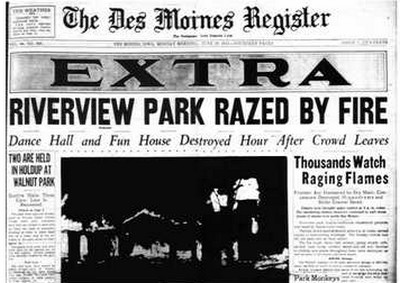
So when Kent started a Facebook page called Lost Des Moines, I immediately asked if I could join. I'm a Des Moines-history buff, and I quickly was drawn in by photos posted by Kent and others of places that my father might have known in his younger days, but have since been felled by the wrecking ball. The discussions on the page deal with historic preservation, local buildings of historical significance, and people's memories of those places.

A few days ago, membership in Lost Des Moines began to grow exponentially. No one knew what prompted the spike, but the growth was fun to watch. With each new name came a new memory, and before long, people were having long, spirited conversations about everything from the old Jewish Community Center to long-forgotten ballrooms and amusement parks.

A few people also began talking about the physicians of "old" Des Moines -- the ones many of us baby boomers visited during our formative years. It seemed many on the site had been patients of a Dr. Corn, and they proceeded to talk in flattering terms about the care the gentleman had provided.

Suddenly, a woman who was new to the site popped up and said, "I'm here with Dr. Corn right now. I'm reading all your comments to him, and he's enjoying them so much."

It turned out the woman was the granddaughter of the now-quite-elderly Dr. Corn. Comments immediately turned to "Please tell him hello from Barb, whose broken arm he set in 1958," to "Please give him a hug for me. I'll always remember the way he took such good care of my brother when he was very ill." The granddaughter then responded that Dr. Corn indeed remembered little Susan or Leonard or Peggy, who then were transported back in time for a poignant few minutes.

I'm sure everyone who happened to be in on that conversation ended up feeling warm and fuzzy inside at the thought of a kind old gentleman who had given so much to so many, bolstered late in life by the knowledge that he had made a lasting difference in the lives of the children for whom he cared.

Kent and I chatted briefly -- via Facebook, of course -- after the conversation about Dr. Corn had ended. We agreed that we had witnessed a special moment, and what had transpired was Facebook at its best. And of course I found myself thinking of my dad, who hadn't really understood Facebook but would have so enjoyed the memories sites such as Lost Des Moines can provide.

As those of you who are reading this via Facebook know, the site is so much more than it's often portrayed. Yes, I see posts about so-and-so drinking too much and am drawn sometimes into meaningless conversations about a TV show. But for me, Facebook is about the kind of interaction prompted by my pal Kent when he dreamed up Lost Des Moines.

I have the utmost respect for people who want to guard their privacy; there are times, I'm sure, when I should be a tad more careful with mine. But if those of us on Lost Des Moines the other night had been worried about our privacy, chances are Dr. Corn never would have known how loved he was. In return for a few more nights like that one, my anti-Facebook friends can make fun of me all they want.


My own former pediatrician, Dr. Marion Alberts, who's been a lifelong friend of our family. He's almost 90. Doesn't he look great?