Friday, November 25, 2011

On Black Friday, what is wrong with us?


I just came across a video of Walmart shoppers trampling one another to grab $2 waffle makers. And I'm horrified -- not because I'm too good to enter into the Black Friday fracas, but because I have. And given the right set of circumstances, I could have been one of those waffle-iron-clamoring folks.

You can see the video by pasting the link below into your browser. The shot of the woman at the :16 mark -- the woman with the short blond hair and too-tight blue t-shirt -- is especially cringe-worthy. Enjoy.

http://www.nypost.com/p/news/national/watch_battle_for_waffle_makers_57XaEkyAvwzRutn1unvkUM

What happens to us when we see a sign that advertises something for less than it's actually worth? Even the most refined of us can turn into barbarians at the gate. And most of the time, we're wasting money, as we're throwing it away on things we don't need and never, ever would have purchased if the sales didn't beckon us.

We're so, so stupid. I'm of course including myself here, as I jumped on the couponing train a few weeks ago. I had covered and written a story about a local woman who does a great job of saving money with coupons; she's not the kind of scary, hoarder-ish extreme couponer you see on the TLC show, but she's halved her family's budget since she began using coupons consistently and responsibly.

Read about her here:

http://www.desmoinesregister.com/article/20111113/COMM/311130054/Extreme-coupon-clipper-teaches-tricks-trade

So of course I decide that I'd like to halve my family's budget, too. I clip coupons for a couple of weeks, stick them in a school-supply box, and hit the grocery store. Sure, I use my coupons, but as a result, I spend more than I've ever spent at Hy-Vee in my entire life. Why? Because quite a few of the items for which I had coupons are things I would not normally buy. (Note: In all fairness to the coupon lady, she had warned us not to do this.)

The moral of the story? I can't be trusted with coupons that advertise deep discounts because, no matter what, I will use them. Seventy-five-percent off a springform pan? It's mine, even though I know I'll never in my life make a cheesecake from scratch. A dollar off a roll of paper towels that normally costs $1.39? I'm there, and I'm buying a bunch of them, even though they're so flimsy that I have to wad together three of them to wipe up a spill. A men's razor that neither my son nor husband needs? I have to grab it, you see, because it's free when you purchase the razor blades.

Here I am, then, on Black Friday afternoon. I had promised myself I'd stay put, but lo and behold, the mall -- and my daughter -- are beckoning. I have some coupons clipped and ready to go, and on my honor, they're for things I really, really can use and would have purchased anyway.

Wait, so you're questioning whether I really need that archery set, the coffee-table book on cats, the ice skates or the 70" x 70" white board? Hmpf. You obviously don't know me very well. :)

Sunday, November 20, 2011

I'm old enough to remember "wish books."


I'm old enough to remember "Wish Books." Are you?

My friend Molly tweeted a photo this morning of her little guys poring over a Christmas catalog, determining the items they might want to place on their Santa lists. And it took me back.

During the Christmases of the late '60s and early '70s, when I was little, we'd wait for the mail to bring the two periodicals that officially ushered in the holiday season: The JC Penney "Wish Book" and the Sears Christmas catalog. We'd fight to be the first to start paging through the pristine pages; it was always best to circle our items before anyone else had a chance, as ballpoint pens tended to slice through the thin, glossy paper and make whatever was on the other side unreadable.

I remember seeing a Mrs. Beasley doll -- Buffy's doll from the '60s sitcom "Family Affair" -- on the pages of one of the catalogs. I circled it and ended up finding her under the tree on Christmas morning. Later, I circled roller skates and turquoise necklaces; even after I was old enough to know the horrid truth about Santa, I circled stereos, telephones, Earth shoes and "elephant" pants.

I first attended college at the University of Northern Iowa before transferring to Drake. I remember coming home for Thanksgiving of my freshman year and not wanting to go back, for some reason or another; I distinctly remember that as I waited in the living room for my ride to pick me up on that Sunday in 1981, I circled a set of electric rollers in the Wish Book.

My kids, 23 and 20 now, were always good about letting me know what they wanted for Christmas. With Scott, it was easy; he didn't like gifts for which he'd be forced to find a place in his room, so as soon as he was old enough to know what they were, he requested gift cards. Caroline would print pages from clothing-store websites and bring them to me.

There was something missing.

We all talk about how commercial Christmas has become; in fact, we were talking about it back then, too, as Charlie Brown began lamenting it on his Christmas special in the '60s. And to some degree, of course, it is too commercial; stores begin showcasing holiday decorations in October, and Thanksgiving is sometimes almost a footnote to the "real" holiday.

And we all have so much less time, it seems, to simply sit back and enjoy the holiday. In the Christmas seasons of my youth, of course parents worked, but we didn't have youth sports and music lessons and take-home piles from the office to steal our attention every night. We could hunker together on the couch, watch Christmas specials, and feel the season begin to warmly advance upon us.

I guess we take that holiday warmth wherever we can find it now. There are new traditions; commercialism be damned, my daughter and I look forward to shopping at midnight on Black Friday. We meander around for a while, enjoying the sights and sounds, and then we hit Perkins for a middle-of-the-night breakfast before heading home to bed. My son says he may join us this year.

And when the kids are home from college, we still gather around the TV for Charlie Brown, the Grinch, the Wonder Years' Christmas episode and Emmett Otter's Jug-Band Christmas (look it up! It's a good one). We talk and we eat and we laugh, and it's clear that the special feelings inherent to the season don't just fall away as we grow older.

But still, I can't help but hope for Wish Book will show up in my mailbox. As the song says, I need a little Christmas -- right this very minute. And there'd be no better way to find it than paging through slippery pages crumpled by a ball-point pen that doesn't have quite enough ink.

Monday, November 14, 2011

Dear Dr. Anesthesiologist, please don't forget to wake me up


I have a 3-inch scar across the base of my neck, an 8-inch one at the bottom of my abdomen and a 6-inch one bisecting my left knee. And the truth is that unless someone happens to ask about them or I happen to catch the reflection of one in the mirror, I usually don't think about them.

Lately, though, they're all I can think about -- the surgeries that led to them, anyway. Unless, of course, I'm thinking about the anesthesiologist not giving me enough medication. Or forgetting to wake me up.

Neuroses are nothing new to me. When I was little, I couldn't go to sleep until I touched all my dresser drawers to make sure they were shut tight and tapped my bedroom doorknob three times with my index finger. Seriously.

As an adult, I learned that I have the "checking" form of obsessive-compulsive disorder, and that makes me pretty lucky as far as OCD sufferers go; I'm not germ-phobic or relentlessly neat. At night, I check door locks and stove knobs. My husband and kids laugh about it, but it doesn't faze them; it's part of who I am, and it doesn't take a whole lot of time out of my day.

Sometimes, though, the neurosis shifts a bit and the obsessive part takes over. And that's happening now, manifesting itself in a near-paralyzing fear of my upcoming surgery. I'm not sure if it's all the footage of Dr. Conrad Murray on the Today Show, or what -- but I'm convincing myself something bad is going to happen.

Cheery, I know.

When I had my left knee replaced three years ago, I was a model patient, calm, cool and collected from the time my surgeon told me the joint needed to go until I woke up in recovery with a wad of titanium tucked under my kneecap. I don't think I spent much time considering that something could go horribly wrong.

This time, though, here's how I picture myself: strapped to the operating table, eyes taped shut, tube down my throat, awake but unable to let anyone know I'm awake. Gruesome? Yup. Realistic? Probably not terribly. But it could happen. And like any good obsessive-compulsive, I'm determined to make that my focus for the next two weeks.

Here's the other scenario: The surgery is over, but the anesthesiologist leaves the room having forgotten to wake me up. Everyone else goes on about his or her life, but I lie there long into the night and wake up still strapped down.

That makes sense, right? Of course it does.

I vacillate between thinking my anxiety is normal -- have you ever seen a knee-replacement surgery? -- and that it's simply part of where I am in my life. In other words, it's not normal, but I understand why I'm feeling this way.

Not to be too melodramatic, but I watched my dad die eight months ago. And I saw how quickly "alive" can become "dead" -- how something that seems so insignificant at the time, such as an intestinal virus, can initiate a chain of events that can result in a person's not breathing anymore. The night before, he was eating ice cream. At 3 p.m. the next day, the nurse was telling us to hurry, hurry, that this was it.

Granted, my dad was elderly, and he was sick. Despite my kids' opinions to the contrary, I'm really not old. And except for allergies and the pesky low hematocrit that keeps me from donating blood as often as I'd like, I tend to be pretty healthy. So the odds are that I'll sail through the surgery, and I'll have a healthy knee to show for it. I'm looking forward to the eventual lack of pain when I walk, and I'm hoping that I'll even be able to alternate feet when I take the stairs.

But I have to get through the next two weeks. When I'm inside my own head, time is my worst enemy. I can touch the stove knobs and check the door locks all I want, but when it comes down to it, the only thing that will assuage will be this: The lights will be bright, and I'll be disoriented, and my knee will feel like it's bigger than my head. And the far-away voice of the recovery-room nurse will be saying, "Honey, it's all over, and you did fine."

Sunday, November 6, 2011

She was mentally handicapped, but I learned from her


Decades ago, my grandma published a book of poetry. I'll always remember it because she infamously referred to my 13-year-old self as "aloof" in one of the poems; it hurt my feelings at the time, but I'm sure she was right. I also remember it, though, because of the way she described Little Louise.

Little Louise was, as Grandma described in the book, "one of God's special children." When she was born in the 1920s, the term "special needs" didn't exist; doctors called her "retarded" and said she should be placed in a facility. Her parents kept her at home, but they both died when Little Louise was young, and she had an older sister who didn't want to be responsible for her.

So to keep her out of a "home," my grandma's parents, Nana and Papa -- probably the two best people I've ever known -- brought her to live with them. Little Louise was Nana's niece, and she became part of the family.

Little Louise had been deemed "unteachable," but she was indeed able to learn; she couldn't read, but she was good at the household tasks that became increasingly proud of completing every day. She worked outside the home from time to time -- in fact, she was a "lunch lady" at my preschool -- and she knew everything about everyone and considered all her co-workers her very best friends. And she was happier than any person I've ever seen. That was, as my Grandma said, because she had no worries.

Little Louise loved family gatherings; we kids were her very favorite people to be around, and she revered holidays with a childlike enthusiasm that she never outgrew. When it was her turn to open presents, she shook with excitement. I still remember the year my dad, whose name was Charlie, gave her a then-popular perfume called, of course, "Charlie."

"Whenever I wear this, Charlie, I'll think of you," Louise said solemnly, and dabbed the fragrance on her wrists. And every time she wore it, you can bet she reminded my embarrassed dad that she was wearing "his" special scent.

As the years passed, Louise remained much the same; we often talked about how little she tended to age over the years. Her face stayed unlined; her red hair stayed red. As the older members of the family passed away -- Papa, Grandpa, Nana and then Grandma -- Louise would express now and then that she missed them, but she lived largely in the moment.

Even when she was the last surviving one of her family members and lived alone in a seniors' apartment, she took great pride in making new friends, participating in every activity the facility had to offer, and showing off her collection of holiday decorations. Wherever Louise was, she was the life of the party; she had few, if any, inhibitions, and was always willing to be the first to try something new.

Things changed a few years ago, though, when Louise suffered a stroke. One side of her body was paralyzed, she became wheelchair-confined and couldn't speak. The last time the kids and Kevin and I saw her was, I'm ashamed to admit, two years ago.

I don't really know why we stopped visiting; I could use the excuse that my dad became ill about two years ago and I was busy helping to care for him, but that wouldn't be entirely true. Louise lived but a few minutes from my house; I could have easily been in and out in the span of an hour.

I didn't go because it was unpleasant to see her that way. I didn't know where to look; I didn't know what to say. I didn't know if she was hearing or understanding me. I didn't know if she knew me. I let others in the family do the heavy lifting, and that's not my nature. I guess I simply chose to drop the ball.

We buried Louise today. It was a small funeral; she had become an old lady, and not many people knew her anymore. My faith assures me that she's getting ready to spend the holidays with the people who took her in and loved her, and for that, I'm grateful. But as is so often the case, I'm looking back, now that it's too late, and wondering why I chose to be selfish.

One of my frequent soapbox topics is the way we in the United States tend to treat our elderly. How ironic that every time I've spouted off in recent years, I haven't stopped to realize that I was part of the problem. An hour a week of my time -- and hour I easily could have given -- would have meant something to her.

"We should go visit Lou," Kevin would say, and I'd ignore him. It would have been so easy to jump in the car and spend a little time simply holding her hand, but still, I resisted. And today, I'm left wondering why I screwed up, and feeling humbled about learning a pretty important lesson from someone who once was believed to be too mentally "feeble" to learn anything herself.

Saturday, October 29, 2011

Isis Goes to School, Day One


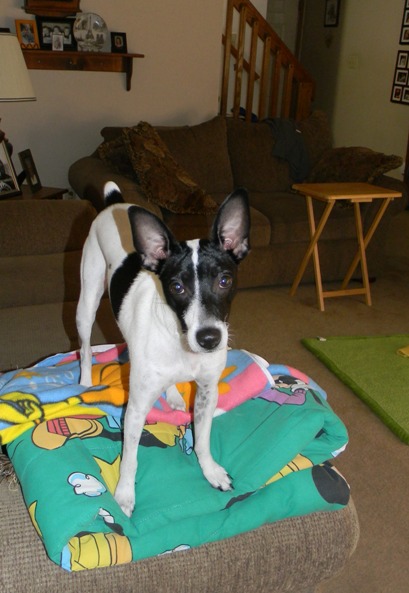
We've had our dog, Isis, for about six weeks now. She's calmed down quite a bit -- about as much as a rat terrier can calm down, I guess -- but still, we figured obedience training couldn't hurt. So, armed with crossed fingers and a pocket full of treats, she and I set out for our first class.

My conclusion: With apologies to David Letterman, here are the top 10 things to keep in mind when taking a dog to obedience class for the first time.

10. If your dog is a little dog and all the other canines in the room make at least two of her, chances are she won't feel terribly relaxed. She may even shake through the entire 60-minute session, and she could also be far too nervous to take the treats that are supposed to be motivating her. And it's difficult for a dog to learn to sit, stay, come, look and all kinds of other interesting things when she leaps into your lap every time another dog barks.(It's also not good to bring Cheerios as treats, even if your dog loves them at home. She'll take one sniff of someone else's Snausage (OK, that might sound dirty, but I promise it's not) and be even less motivated to do cool things for you.)

9. If you're feeling terribly organized and superior for having all your dog's records in one folder and bringing the folder to the meeting, your humility will be restored by the looks of other people in the class when they notice your papers are in a Justin Bieber folder. Yes, I'm serious, and don't ask.

8. If you're paying $109 for a class and there are four dogs in it, your trainer should remember the gender and perhaps even the name of your dog. I'm just saying.

7. If some dogs are known to behave excitably toward strangers or other dogs, it's probably not the best idea to hold the class in a room with one wall that's entirely a window and offers a near-constant flow of others, human and otherwise, walking past.

6. It's almost impossible for the average human to give a dog a treat, pet her, say "Good dog," and click a clicker at the same time. (Or maybe it's possible for the average human and impossible just for me. At any rate...)

5. Don't judge the people in your class. The guy in the cowboy hat -- the one with a mouthful of chew and a homemade tattoo on his forearm -- might be a redneck, but he also might freely offer to share his name-brand treats with your dog. This might actually distract her enough so that she stops shaking.

4. It's OK to feel superior to the classmate whose dog is wearing a sweater.

3. It's also OK to feel superior to the classmates -- two of them -- who obviously named their dogs after "Twilight" characters.

2. It's best to avoid taking it personally when the trainer responds to your comment about a clever trick you've been using with your dog by shaking his head and saying, "Nope, that's not effective. In fact, it's just noise."

And the No. 1 thing to keep in mind when taking your dog to obedience class for the first time:

1. If she chooses to relieve herself by leaving a No. 2 on the way out the door -- even though she never has accidents at home -- you might just end up feeling as though you really, seriously can't blame her.

P.S. The good news -- after I got her home, away from the trainer calling her "he" and the three giant attack dogs, she learned to sit. All it took was a handful of Snausages and, curiously, the absence of a clicker.

Tuesday, October 25, 2011

Psychic, huh? Find some missing babies.


So as anyone who knows me is aware, I’m a sucker for TLC shows. From “19 Kids and Counting” and “Little People, Big World” to my current fave, “Sister Wives,” I can’t get enough of the “reality” TV offered up by the cable channel.

But try as I might, I can’t get into “Long Island Medium.” And here’s why – I’m pretty darned sure she’s a fake.

Theresa Caputo is a bleached-blond, gum-chomping Long Island mom who just happens to communicate regularly with the dead. As another blogger put it, she’s sort of a UPS delivery person for the deceased, dropping in at homes and businesses to tell people such things as, “Your grandfather visited me and wants me to tell you you’re a great dad.”

Nice sentiment, but I’m calling “foul” all over the place. As a chronic information-gatherer, I can tell you with great certainty that virtually anything Theresa tells anyone can be found online … maybe not specifically, but if you dig a little, it’s there.

Case in point: Theresa and her teenage daughter walk into a bakery to buy some cupcakes. They order, and Theresa says, "I need to do a reading." The cupcake people look at her strangely and she says, "I'm getting a vibe -- is this a family business?"

Prior to the trip, she or a producer or an assistant easily could have Googled the store. "(Store name here) has been in the (name here) family for three generations," the website could have read. There's your "psychic" reading.

The rest of the cupcake visit goes much the same way. The owner, her husband and an employee appear to be in their 50s; "Did an older person in your family recently pass?" Theresa asks. It's a pretty safe bet that in the last few years, someone might have lost a parent or aunt or uncle.

Gasps all around: Amazingly (!), the owner's father had died in the past year. And wouldn't you know it: He's there! At that moment! To talk to the owner, via Theresa the Psychic!

"All I wanted was a cupcake," the teenage daughter tells the camera. Indeed.

Don't get me wrong; I think Theresa probably feels things strongly and may even have some sort of intuition. And she's not doing a bad thing; telling a grieving woman that her dead husband is OK and loves her very much can't be anything but comforting.

But it's also sort of a no-brainer. If she's truly a psychic, why isn't she finding missing college students or kidnapped babies?

I don't fault Theresa for taking advantage of a good situation. She's an Italian girl, so of course she's smart! She has two kids to put through college. She's not hurting anybody. So what's the harm?

The harm, I guess, is that people are on TV with their grief laid bare, and other people -- including me -- are tuning in to watch it. Maybe I'll feel differently if Theresa calls me and tells me my late dad is trying to get ahold of me. In the meantime, I don't think I'll watch anymore.

Friday, October 21, 2011

Could it be that age makes us more tolerant?


Does growing older make a person more or less tolerant? I can't decide.

I have a friend I love dearly. This friend actually made me homemade chicken soup last week when I was sick -- left work early, bought the ingredients, brought it to my house and sat with me while I ate the first warm, wonderful bowl. Who does things like that? Not my husband. Not my family. This friend.

So that probably explains why I didn't want to hit her with a club when she began extolling the virtues of a certain presidential candidate. It also probably explains why I went upstairs and grabbed her a recent issue of TIME Magazine that profiled that candidate. And it may even explain why I didn't begin hyperventilating when the conversation swung around to her feelings about Chaz Bono's presence on "Dancing With the Stars." (Hint: She doesn't like it.)

After she left, I began wondering about the nature of relationships as we age, and whether we tend to become more or less tolerant of people, even close friends and family members, whose views differ from ours. On one hand, I'm more resolute in my opinions than I've ever been. But on the other hand, I'm probably a little more inclined to acknowledge that everyone doesn't have to believe the way I do (although, of course, I'd like them to).

Some of my memories of my dad's last few years may bear me out on this hypothesis. I'm thinking specifically of the day Iowa legalized gay marriage. I visited Dad and felt inclined, against my better judgment, to ask him, "So, what do you think about what happened today?"

I half expected a response somewhere to the far right of the most closed-minded Archie Bunker statement, but to my delight, my then-89-year-old father responded: "Here's how I feel about gay people. If they don't bother Charlie Lavia, Charlie Lavia won't bother them."

I laughed, of course, at the notion of random gay people somehow "bothering" Charlie Lavia. But then I thought: Age has mellowed him. There's no other explanation.

As for me, I'm not so sure what's going on. There was a time in my life I tended not to want to rock the boat when it came to politics: My first husband's views were and are in direct opposition to mine, and during the '92 presidential campaign, I allowed the wife of my then-husband's candidate to hold our then-baby for a photo op. I may have even taken pictures. I was more or less willing to try to see the good in everyone who was willing to run for public office, and I didn't pay much attention to the internal voice telling me, "You really, really don't agree with that person."

Twenty years later, I don't think twice about arguing with anyone and everyone about my rather strong convictions. What changed? On the inside, nothing. I think the only reasonable explanation is that I simply care far less about whether people like me. And I think that lack of concern comes (happily) with age.

It makes sense: Now that I'm more secure about my opinions, it's easier to share them. I can sit across the table from Diane, my soup-making friend, and feel fairly sure that our relationship runs deeper than the outcome of the next election. Do I think she's wrong? Heck, yes. Will I keep trying to change her opinions? Of course. But I'll also respect the fact that she has a generous, loving heart.

After all, if I judge, I'm behaving like the groups of people with whom I so vehemently disagree. Being open-minded means more than affirming the opinions of those who think the way I do.

I believe people are intrinsically good, even the ones whose politics don't mirror mine. I believe most of us operate from a deep moral sense of what we believe to be right and just, and that even when I think people are a little "off" -- or even dead wrong -- it's my duty as a human to try to understand where they're coming from.

Diane doesn't disagree with me because she's argumentative or obstinate. She disagrees because she was raised a certain way, is married to someone who believes a certain way, and is influenced by the way she interprets her church's teachings. Similarly, I disagree with her because of the experiences and events that have shaped me. We get that about one another, and the conversations -- even when reaffirming that we're on opposite sides of the fence -- always are good-natured and respectful.

I'm really pretty positive that as I get older, my politics won't change. But I'm also pretty sure that I don't want to be the kind of bitter old lady who is so intolerant of others' beliefs that she turns away the chance at real relationships.

So even if I think you're 101 percent misguided and shouldn't be allowed near a voting booth, you have my word that if you're not harming anyone, I'll respect your right to a conflicting opinion.

And I'll respect you even more, it goes without saying, if there's homemade soup involved.